

“Before there was a number, there was a name: Aron Löwi.
Five days in Auschwitz and a photograph that survived his tormentors.
To remember is to resist.”
Who was Aron Löwi?
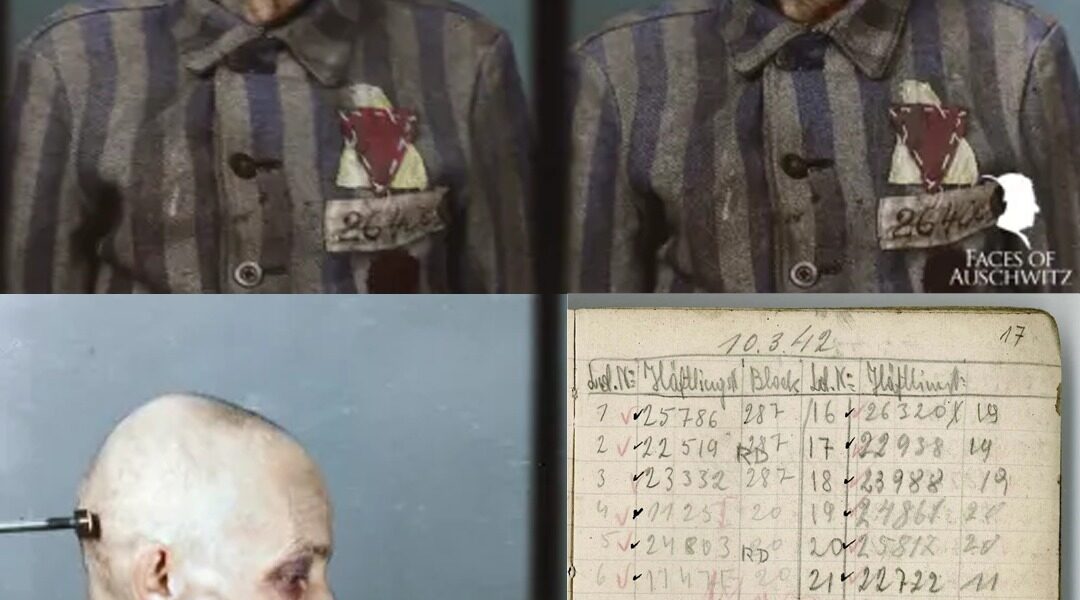
Aron Löwi was a Jewish merchant from Zator , a small Polish town. On March 5, 1942, his name was reduced to a number: 26406. Transferred from Tarnów prison to Auschwitz, he was 62 years old: old enough to have known a full life, young enough to still hope for peace. He died five days later , on March 10, 1942 .
What the photographs reveal:
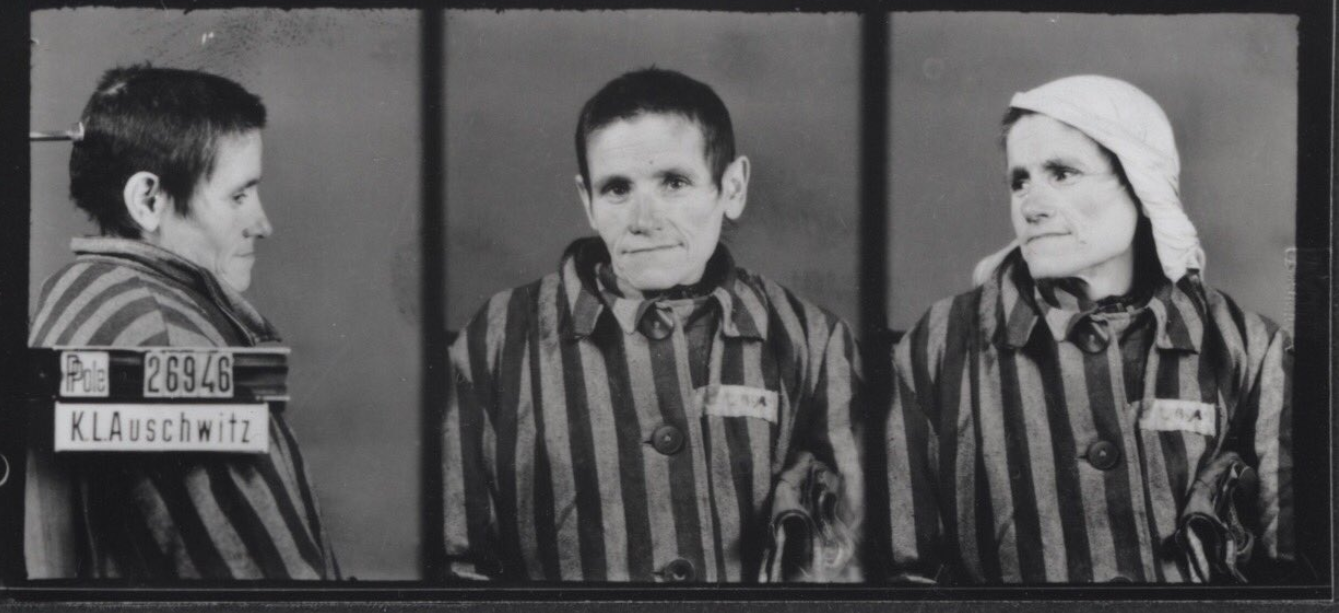
The three portraits (frontal, profile, and three-quarter view) follow the protocol of the camp’s identification service. The
triangular insignia prescribed by the SS are visible on Aron’s striped jacket.
- Yellow to mark Jewish identity ;
- Red for the “political” category .
In many cases, these triangles were overlapped to create a six-pointed two-color star, a system that depersonalized and classified prisoners through colors and categories.
In his sunken eyes, in the still visible bruises, we read disbelief , exhaustion , and that form of silent resistance in the face of the unimaginable. The photographs were taken at the moment when heads were shaved, personal effects confiscated, and a name replaced by a number .
Five days, a single line in the register.
A page in the register dated March 10, 1942 , documents Aron Löwi ‘s administrative registration . Like so many others: no grave, no farewell : just a short line in a notebook and a few photographs. Premature deaths, often within the first week, were frequent: hunger, cold, disease, violence .
Portraits as evidence and as restitution.
The Auschwitz-Birkenau State Museum today preserves tens of thousands of registration photographs, only a fraction of the total collection destroyed during the Nazi retreat. Restoration and contextualization projects like ” Faces of Auschwitz” restore a face, a biography, a voice to those whom the bureaucracy of murder had reduced to codes .
These images are legally admissible evidence , but also moral dialogues : they force us to look, to name and to recognize the person behind the striped uniform. Every time we pronounce the name Aron Löwi , the machine that claimed to be able to erase him fails again .
Why look further?
Because the photograph has outlived its creator.
Because memory lasts longer than hatred .
Because memory is a form of resistance , a way to give back to Aron Löwi and so many others what was violently taken from them: their humanity .