

When Adolf Hitler developed his strategy for the Ardennes counteroffensive, he knew that capturing at least one intact bridge over the Meuse was crucial. Given his ambitious goal of creating a rift between the US and British armies, crossing the Meuse, and advancing to the coast near Antwerp, speed was paramount to Hitler’s plan. If the Germans failed to capture an intact bridge over the Meuse, the resulting delay would give the Allies time to recover from the surprise effect and assemble troops west of the river before the Germans could cross. To prevent this, Hitler assigned SS-Obersturmbannführer Otto Skorzeny a special mission called “Operation Greif.”
Hitler summoned Skorzeny to his headquarters in October 1944 to personally deliver his orders. Skorzeny had previously led secret missions for Hitler, including the liberation of Benito Mussolini, but this would be his largest and most complex. He was tasked with equipping and training a commando unit to advance alongside the Sixth Panzer Army, the spearhead of the Northern Offensive. In addition to capturing at least one bridge over the Meuse, the commandos were to sow chaos in the Allied rear through espionage and sabotage.

To achieve this goal, Skorzeny resorted to deception, sending English-speaking soldiers dressed in American uniforms and equipment. Hitler explained to Skorzeny that the Allies had used the same ruse in recent battles. He assured his loyal commander that disguising themselves as Americans would only violate the laws of war if German soldiers went into battle disguised.
Skorzeny established his command at Grafenwöhr. With only six weeks to prepare, he had his hands full. Hitler promised unconditional support, but like most of his claims regarding the Ardennes counteroffensive, this was an exaggeration that never materialized. Skorzeny received significantly less American equipment than expected: only a few dozen jeeps, trucks, and half-tracks, as well as a Sherman tank. To compensate for this shortfall, he equipped his main force, Panzer Brigade 150, with about 70 German tanks disguised as American armored vehicles.

A destroyed M10 replacement with American markings on the hull and turret. Photo source
In a serious breach of security, German Field Marshal Wilhelm Keitel sent out a message seeking English-speaking volunteers from across the Wehrmacht to serve in a special unit led by Skorzeny. Approximately 2,000 men responded to the message, which also attracted the attention of Allied intelligence officers. As it turned out, most of the volunteers knew little more than a few words of English. Only ten spoke it fluently, and a few dozen others could converse. Skorzeny organized the best English speakers into the Stielau Unit, a reconnaissance unit composed of teams of two to six men, equipped with jeeps, radios, and a few explosive devices. Most of these men had no command experience and, with only six weeks of training, had only time for rudimentary training.
During training, a rumor spread among the commandos that their mission involved the assassination of US General Dwight Eisenhower. Despite Skorzeny’s attempts to quell the rumors, he persisted. Soon, American intelligence officers also learned of the rumor. Ironically, this led to perhaps the mission’s greatest success. When the counteroffensive began on December 16, 1944, reports quickly emerged of German soldiers disguised as Americans operating behind enemy lines. These reports spread, leading to a significant overestimation of the number of commandos involved in the operation. However, enough were captured to make the threat seem real and significant. Many of the captured commandos told their captors that the assassination teams were hunting high-ranking Allied officers, prompting Generals Eisenhower and Bradley to remain at their headquarters to avoid detection. This severely hampered their ability to respond to the German attack.

Although the threat to the American generals was never as dire as feared, the commandos of Stielau’s Unit succeeded in sowing chaos within Allied lines. One team, posing as a traffic control post at a crossroads, sent an entire regiment in the wrong direction. Another disrupted communications between General Bradley’s headquarters and the U.S. First Army command post. Although the commandos were far too small to carry out all the actions later attributed to them, their acts of sabotage, real or perceived, hampered the American response to the counteroffensive and significantly damaged morale.
The German counteroffensive completely surprised the Allies, but quickly stalled due to stronger-than-expected resistance. Skorzeny’s plan for the 150th Panzer Brigade called for a rapid breakthrough, allowing his camouflaged troops to penetrate the American lines. This, however, did not materialize. On the second day of the attack, Skorzeny realized the game was over and ordered the brigade to be operated as a conventional unit, subordinate to the I SS Panzer Corps. Skorzeny’s fight came to an abrupt end when he was wounded in the face by artillery fire near the Hotel du Moulin in Ligneuville, Belgium.
Wilhelm Schmidt, Günther Billing, and Manfred Pernass after their capture by American troops. Courtesy of the National World War II Museum.
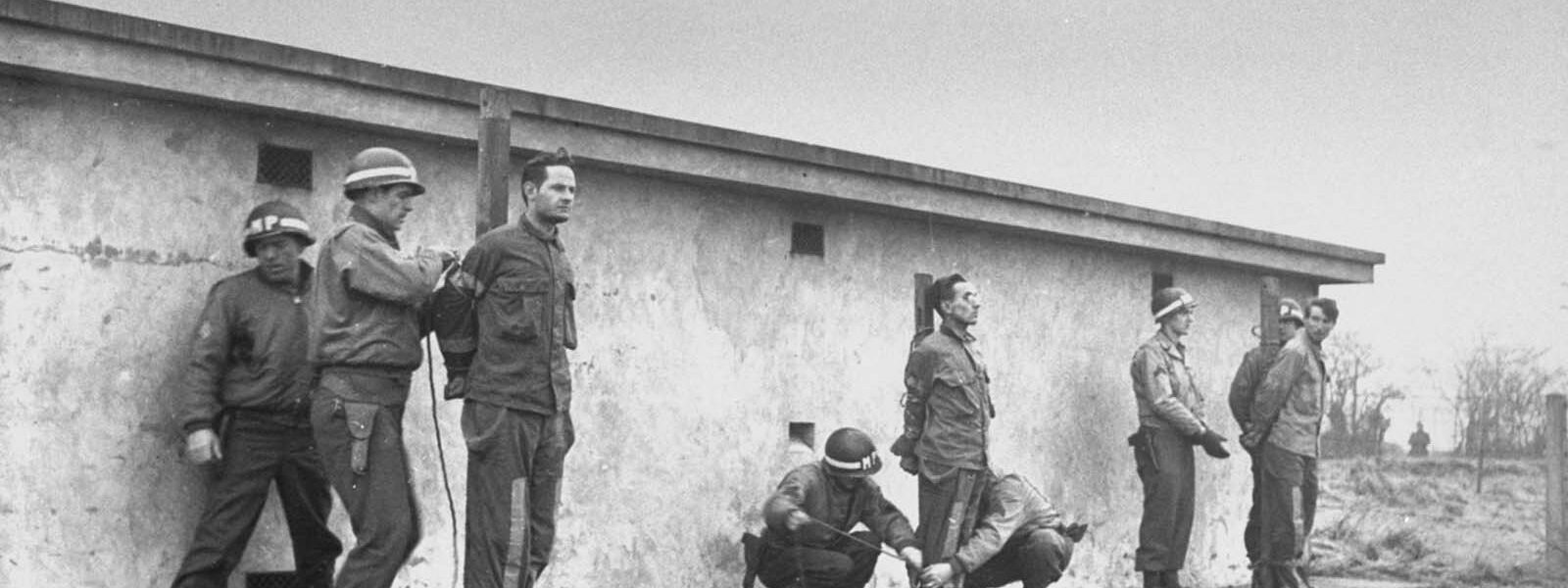
Meanwhile, Skorzeny’s commandos continued their mission, but most were killed or captured by American troops. Only one squad returned to German lines. On December 18, 1944, American troops captured three members of Stielau’s unit in Awaille, Belgium: Ensign Günther Billing, Sergeant Major Wilhelm Schmidt, and Private Manfred Pernass. On December 21, a military commission met at the Master Interrogation Center of the First U.S. Army in Belgium. The commission indicted the defendants and found them guilty of two counts: violation of the laws of war (for appearing in an operational zone in American uniforms) and espionage (for gathering information for the enemy under false pretenses). The commission recommended the death penalty for all three commandos.
German infiltrators lined up to be shot after being convicted by a military tribunal for wearing American uniforms during the Battle of the Bulge. December 23, 1944. Photo: https://rarehistoricalphotos.com/german-commandos-captured-american-uniform-1944/
Supreme Court Justice Colonel E.M. Brannon conducted the required review of the proceedings the next day and upheld the court-martial’s findings. Lieutenant General Courtney Hodges, commander of the U.S. First Army, approved and confirmed the sentences that same afternoon. The Provost Marshal carried out the executions the following morning, December 23, 1944.
Skorzeny himself was not held accountable for his role in Operation Greif until after the war. In May 1945, he surrendered to the 30th Infantry Regiment and spent two years in pre-trial detention. High-ranking Nazi officers tried by the International Military Tribunal in Nuremberg fared poorly: most were sentenced to death or life imprisonment. In August 1947, Skorzeny’s trial finally began before the General Court of the Military Government in Dachau. In his testimony, he admitted his role in the commando operation, but with the help of his skilled US-appointed defense attorney, Colonel Robert Durst, Skorzeny’s account began to sway the court. He emphasized that American soldiers had worn German uniforms on several occasions, such as during the fighting at Aachen, and insisted that he had ordered his commandos to remove their American uniforms before engaging in combat.
Ultimately, the startling testimony of a Royal Air Force officer, Squadron Leader Forest Yeo-Thomas, convinced the court in favor of Skorzeny. Yeo-Thomas, a British agent known to the Germans as “The White Rabbit,” described how he escaped German captivity by disguising himself and several fellow prisoners in enemy uniforms. He argued that this was no different from Skorzeny’s use of American uniforms to disguise his commandos. Unlike the military commission that convicted Schmidt, Billing, and Pernass, the Dachau tribunal acted on the basis of international humanitarian law, which considered wearing enemy uniforms a war crime only if the accused participated in combat in disguise. Based on this interpretation of the law and Yeo-Thomas’s compelling testimony, the court dismissed the charges against Skorzeny and his co-defendants.
Skorzeny remained in custody until July 1948, awaiting a denazification court ruling. He then escaped with the help of three former SS officers disguised as US military police officers. He later claimed to have escaped with US support. In 1952, Skorzeny was living in Spain when a former German general with CIA ties recruited him to train the Egyptian army. He later lived in Argentina, where he was rumored to have served as an advisor to President Juan Perón and as a bodyguard to his wife. In the 1960s, he was recruited by the Mossad, although his motives for collaborating with the Israelis and the missions he performed remain a matter of speculation. He died of lung cancer in January 1975 and was cremated after his funeral in Madrid. His ashes were transferred to his hometown of Vienna, where former SS officers attended his funeral. His figure remains controversial. Some consider him a racist and a war criminal, while others admire him as a courageous adventurer and pioneer of commando tactics.