
In the dying winter of 1945, Bavaria lay silent beneath a white shroud of snow. Villages that once waved Nazi flags now stood hollow, their chimneys dead, their people starving. Somewhere down the winding road, the rumble of engines echoed. American trucks, their olive green paint caked with mud.

Inside were not bombs or soldiers ready to shoot, but boxes labeled US Army rations. Chimneys smoked with the last of the firewood, and what little food remained was hidden under loose floorboards as if it were treasure. Mothers boiled snow to trick their children into thinking soup still existed. Every cough in the night echoed through the thin walls of the ruined houses, a reminder that hunger was not quiet.
It had a voice, and it called from every corner of the village. In one such home, a woman named Martya knelt beside a pot of water that held only a single shriveled potato. Her hands were red and raw from cold, her breath a ghost in the dim light. Her son, Emil, no older than seven, sat by the window in a wool coat two sizes too large.
He watched the empty road outside where the wind blew fine streaks of snow across the frozen ground. His voice was barely a whisper when he asked if their father would come back. Marty did not answer. There were no words left that did not hurt. Outside the church bell hung frozen, its clapper silent.
Most of the men who once rang it were gone. Some to the eastern front, some to the grave, and others simply vanished in the chaos of retreat. Only women, children, and the elderly remained. Ghosts of a country that had run out of soldiers. In the evenings, the villagers gathered in the cellar beneath the old inn, lighting candles that made their faces look like portraits painted by fire light.
They spoke little except to trade rumors, that the Americans had crossed the river, that they shot prisoners, that they brought food, that they burned farms. Truth and lies had become the same currency, spent easily, spent often. It was said that a convoy of American trucks had been seen near Augsburg, moving slowly through the snow.
Some villagers prayed they would never come. Others prayed they would. The children, too young to understand the difference, played in the road with tin cans, pretending they were soldiers. Every sound of an engine made them scatter into doorways, half in fear, half in hope. In the mornings, the sky was the color of steel. Smoke from distant towns drifted on the wind like ghosts searching for homes.
The Reich was dying, not with a bang, but with the slow, pitiful collapse of hunger. Rations in the region had fallen below a thousand calories a day. Bread was a luxury, milk a memory. There were no cats left in the village. They had all been eaten. The baker’s wife was caught digging in the field for frozen turnipss.
When asked why, she said, “Because I still want to see spring.” One afternoon, the sound of marching boots echoed down the main road. It was not Americans, but the last remnants of German soldiers, boys in gray coats, holloweyed and limping, rifles slung without bullet. They passed through without a word, their faces blank. One of them dropped a letter written to mother, but the wind carried it away.
When they disappeared into the forest, the silence that followed felt heavier than the snow. That night, Martya heard the whimper of her son. He was dreaming again, something about bread. She wrapped him in her own blanket and whispered stories about the farm they used to have before the war. The smell of apples in the cellar, the way his father’s laugh filled the rooms.
But even memories seemed thinner now, fragile as the paper the propaganda was printed on. She wondered if the Americans would be monsters, or if monsters could be kind. She had heard both versions, and hunger no longer cared which was true. Days blurred into one another. Snow fell, melted, and froze again.
The old men at the inn started carving spoons out of fence posts, saying it was to keep their hands busy, but everyone knew they were waiting for surrender, for death, for something better than this. A radio in the mayor’s house still worked, its crackling voice filled with promises of secret weapons that would save them. No one believed it anymore.
Even the children had stopped drawing victory flags in the dirt. Then came the sound, a low rumble, faint but steady from beyond the hills. Emile was the first to hear it. He ran to the window, pressing his face to the cold glass. “Mama,” he whispered. “They’re coming.” Marta went to him, her heart pounding.
Outside, the wind carried the faint growl of engines, a sound she had not heard in months. The villagers stepped out of their homes one by one, eyes narrowed against the light. Far down the road, through the mist of falling snow, dark shapes moved, slow, heavy, metallic trucks. Old Fra Weber crossed herself.
“Americaner!” she breathed, the word half prayer, half warning. Some ran to hide their meager possessions, others clutched their children. Martya stood still, frozen between terror and relief. Her mind spun with the stories of towns burned, of women dragged away. Yet the part of her that was mother, not German, whispered something else.
What if they bring food? The engines grew louder. Dogs barked from behind broken fences. The lead truck came into view, its headlights cutting through the snow. The American flag fluttered faintly on the side, dirty and torn. Soldiers in olive coats sat in the back, their helmets dusted white. One raised his hand in greeting. Another tossed something to the ground.
a small rectangular tin that bounced once and landed near the well. A child darted forward before his mother could stop him. He picked it up, turning it over in his mitten hands. It was a can of milk. Real milk. Marta’s breath caught. The boy’s mother began to cry, not loudly, but with the quiet disbelief of someone whose world had just cracked open.
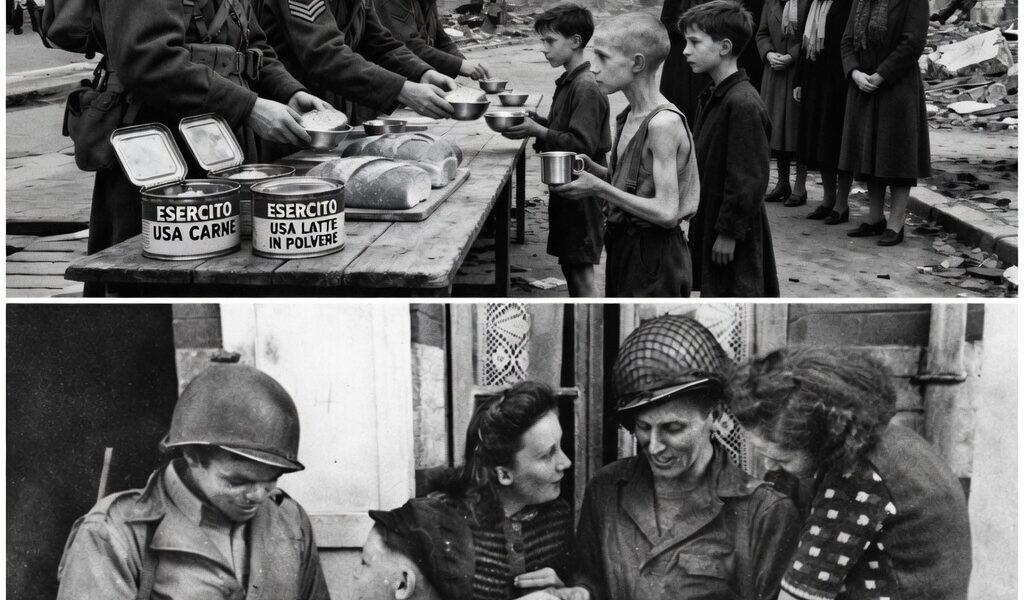
The Americans climbed down, moving slowly, cautiously, their rifles slung behind them. One of them smiled. “No guns,” he said in broken German. “Only food.” For a moment, no one moved. Then another soldier opened the truck’s back gate, and began handing down boxes, brown crates stencled with US Army rations. Inside were things the villagers had forgotten existed.
chocolate, spam, powdered eggs, even coffee. The smell of it drifted through the air like something holy. Martyr reached for Emil’s hand, squeezing it tightly as if to keep from falling apart. The soldiers worked in silence, their breath misting in the cold. One saw Marta and her son standing by the door and nodded.
From his coat, he pulled a folded blanket, olive green and heavy, marked in black letters. property of the United States. He placed it in her arms without a word. The warmth of it felt unreal. Martya looked up, trying to speak, but her throat closed. Behind the soldier, another man laughed softly, tossing a chocolate bar to a group of children who squealled and ran after it.
Snowflakes drifted through the air like feathers. The village that had been silent for months was filled with voices again, not shouting, not orders, but laughter. Martya held the blanket to her chest, tears freezing on her cheeks. She turned to Emil, who looked up at her, eyes wide.
“Mama,” he said quietly, “Are they the bad men?” She looked at the soldiers, “Boys, really tired and kind, standing in the snow.” “I don’t know,” she whispered. “But they brought us bread.” And far down the road, the convoy kept coming. The trucks rolled in slowly, engines humming like distant thunder over the snow. The soldiers who stepped down looked nothing like the monsters of German radio stories.
They were young, too young, Martya thought, staring from her doorway. Their faces were ruddy with cold, their eyes alert, but gentle, their hands cracked from weeks in the field. Some wore wedding rings, others carried photographs tucked behind jacket buttons. They moved with the exhaustion of men who had seen too much and slept too little.
When one of them smiled, the villagers flinched, unsure if it was a trick. Private Ray Thompson, 19 years old from Iowa, had never seen such silence. He had crossed France and Belgium without stopping long enough to notice the people. But this place felt different. There were no guns, no shouting, only the sound of snow crunching beneath boots and the quiet breaths of women watching from behind doorframes.
He caught sight of a boy peeking from behind his mother’s skirt, eyes round as coins. Ry reached into his pocket, pulled out a small wrapped square, and knelt down. “Here,” he said softly, holding out the chocolate. The boy didn’t move. The mother’s hand tightened around his shoulder. Only when Ry broke the bar in half and took a bite himself did the boy dare to reach for it.
The first taste made him smile wide, disbelieving. The mother covered her mouth as tears welled up. Across the street, Sergeant Miller directed the men unloading crates from the truck. “Easy now,” he said. “They ain’t got much left here. Let’s not break what little they do.” The boxes bore familiar stencils.
US Army rations class C. Inside were cans of meat, powdered milk, sugar, and the strange luxury of coffee. For most of the soldiers, these supplies were standard issue. For the villagers, they were miracles in tin. A few women approached hesitantly, their shawls pulled tight around thin faces. They spoke in broken words, some German, some English, some only gestures.
One pointed at a can and whispered, “Kinder?” Miller nodded, pressing it into her hands. She looked down at the label as if afraid to touch it, then clutched it to her chest and began to sob. It was not pity the soldiers felt, but something heavier, a kind of shame that came from realizing mercy could hurt. Ry glanced around at the hollowedeyed children, their bare feet wrapped in rags, and muttered, “Hell, Sarge, they’re just kids.
” Miller didn’t answer. He knew what the boy meant. Only months earlier, these same people had cheered for the men who tried to kill them. Yet now, faced with starvation, the war seemed absurd, a bad story told by men who never went hungry. As more soldiers arrived, the scene grew almost festive in its awkwardness. Someone set up a small stove and began boiling water for Coco.
The smell drifted through the air like a memory from before the war. An old man approached, hand in hand, and offered a quiet denkey. The Americans nodded, though most of them didn’t understand the word. “We’re not here to hurt you,” one said. “We’re just tired of fighting.” The translator, a corporal from New York, whose mother had been born in Bremen, stepped forward to bridge the silence.
“His German was rough, but it was enough. No soldiers,” he told the villagers. “Only food, only peace.” That phrase spread through the crowd like warmth. The tension that had frozen, everyone began to thaw. Mothers led their children closer. The Americans handed out blankets, cans, and bread from field kitchens.
The contrast was staggering. Olive uniforms against torn coats, abundance against emptiness. The villagers hands trembled as they accepted the gift. To touch kindness felt dangerous, almost disloyal to their suffering. Some crossed themselves, others could only stare. Martyr stood back, watching as Emil clutched his can of milk.
The soldier who had given her the blanket earlier now offered her something else, a tin of meat. She hesitated. Pride and hunger wrestled quietly inside her. Then Emile tugged her sleeve, whispering, “Please, Mama.” She nodded, taking it with both hands. The man smiled. Eat,” he said simply, tapping his chest. “Eat.” It was not a command, but a prayer for the Americans.
This was part of the mission. The civil affairs units had been told to prevent famine in occupied territories. Orders were orders, but no one had prepared them for the emotion of it. Lieutenant Harper, who led the convoy, stood at the edge of the square, watching his men at work. He had read the reports.
Millions displaced, rail lines destroyed, cities reduced to rubble. But numbers had no faces until now. A woman wrapped in a threadbear coat approached him, carrying a baby barely old enough to walk. She offered the child forward, not in surrender, but as if to show proof of life. Harper bent down and touched the baby’s cheek. It was cold as marble.
“We<unk>ll get you warm,” he murmured. His voice broke on the last word. By late afternoon, the air filled with unfamiliar sounds, metal cans clanking, children laughing, the hiss of boiling water. One soldier played a harmonica, the notes thin but sweet. Villagers gathered around the fire, sipping from tin cups.
A few began to speak haltingly about the past months, the ration cards that meant nothing, the burned fields, the missing fathers. The translator listened quietly, then told Harper. They thought we would kill them. Harper looked at him, startled. Kill them? Why? The man shrugged. Because they were told we were the same as their army.
Harper gazed at the villagers, their thin faces lit by fire light, their eyes heavy with relief, and said quietly, “Then maybe this is how we win.” But not all the faces were soft. Near the church ruins, two German men stood watching. The last remnants of the local folkster, still wearing faded armbands. Their expressions were tight, their posture rigid. They did not approach.
When a soldier offered them bread, they turned away. “We don’t need your pity,” one muttered. Yet his eyes betrayed him. They lingered on the food too long. The Americans said nothing. Harper simply nodded to his men to leave them be. He understood pride. Even broken nations had their ghosts. As dusk settled, the convoy prepared to move to the next village.
The soldiers packed the remaining supplies into smaller crates, leaving behind more than they were ordered to. Ray handed Emile his empty chocolate wrapper. Keep it, he said with a grin. Lucky charm. Emile nodded solemnly, folding it as if it were gold. Marta approached to thank him, searching for words. Why? Why you do this? She asked.
Her accent was heavy, her eyes searching. Rey hesitated because my mama would want someone to feed me if I was hungry. For a long moment, they simply looked at each other. Two strangers on opposite sides of a war that had devoured everything. The wind carried the faint sound of church bells somewhere far away. Maybe another village being freed. Maybe just memory.
The soldiers climbed back into their trucks. Engines roared to life. Children waved with mitten hands. The villagers stood in the road, framed by the soft glow of fire light and snow. As the convoy disappeared beyond the ridge, the silence returned, but it was not the same silence that had haunted them before.
It was softer now, full of echoes of laughter and the smell of cocoa still hanging in the air. Marta pulled a meal close beneath the American blanket. “They came with bread,” she whispered almost to herself. And somewhere beyond the hills, in the fading blue light, shadows moved again. Figures in torn gray coats, watching the trail of trucks.
Not everyone welcomed mercy. In the days that followed, the village lived in a strange quiet, a quiet filled not with fear, but with confusion. The Americans had left behind food, blankets, and something harder to name, doubt. For years, the people had been told that mercy from an enemy was a lie, that compassion was a weapon.
Yet the tins of milk and bread on their tables said otherwise. Marta stood in her kitchen, staring at a can marked in English letters she couldn’t read. Her hands trembled as she opened it. Inside was meat, pink and fragrant, smelling faintly of smoke and salt. She hadn’t smelled real food in months. Emile watched her, his eyes shining.
When she handed him a piece, he hesitated as if taking it would break a rule. Then he ate. He didn’t speak, just chewed slowly, staring out the frosted window where the snow was melting into streams. The villagers began to gather again in the square, no longer hiding behind doors. The soldiers had promised to return, and though no one quite believed them, everyone waited.
Old Fra Weber brought out a cross from her cellar and hung it back in the chapel, saying, “If God sends angels, they don’t always wear white.” The baker’s wife, who once bartered for turnipss, baked her first loaves in months using the flour the Americans had left. When she handed a piece to Martya, she whispered, “I can’t believe it. They feed us like friends.
” But Martya said nothing. She was afraid to hope too much. Hope was a dangerous hunger. Two days later, the rumble came again, the familiar low thunder rolling over the hills. Children ran to the road, shouting, “Die americaner! Die Americaner!” This time, the soldiers arrived smiling, calling greetings in broken German.
Private Ray jumped down first, his rifle slung harmlessly behind him. “Afternoon, folks,” he said, though few understood. The translator followed, announcing they’d come to bring more food and check the sick. It felt like a dream, like the war had paused and forgotten to tell them. One soldier carried a metal pot and ladle.
Another unloaded blankets from the truck. “Ray spotted Emil standing by the well and crouched beside him. “You like milk?” he asked. Emil nodded shily. “We brought more.” He pointed to a crate filled with tins, tapping one with a grin. Strong bones, right? The boy didn’t understand the words, but laughter bridged the gap.
Marta approached cautiously. She told herself she wouldn’t speak to them again. It was safer not to feel gratitude toward men in uniform. But something in Ray’s calmness, the way he looked at the villagers without pity, drew her closer. Nearby, a group of villagers stood apart. Among them was her Krueger, once a local party official, his arm still bound in a tattered armband.
He muttered to anyone who would listen. They poison us with kindness, he hissed. You’ll see. They make us beg, then take our pride. A few nodded uneasy, torn between his words and their empty stomachs. When one young mother said softly, “They gave my baby milk.” Krueger spat on the ground. Milk today, chains tomorrow.
His voice trembled, not from strength, but from a fear he refused to name. The Americans ignored him. They went about their work with quiet efficiency, setting up a small aid post near the church. A medic examined an old man’s frost-bitten hands, wrapping them in clean gauze. Another handed soap to a group of children, showing them how to wash properly.
They laughed as bubbles formed, marveling at the smell. One little girl pressed the soap to her face, breathing it in as though it were a flower. Ry watched her and smiled, but there was sadness behind it. Later, when Sergeant Miller caught his eye, he murmured. Reminds me of home. Miller nodded. Yeah. Only difference is these kids never had a home left to go back to.
By midday, the square smelled of cooking. The soldiers had heated tins of stew, stirring them over small fires. The scent drifted through the streets, drawing out even the wary. People brought old tin bowls, cups, anything that could hold warmth. Martya found herself in line with her neighbors. When it was her turn, Ry filled her bowl generously, nodding toward Emile. “For him, too,” he said.
She looked down at the thick broth. Chunks of potato, real meat, floating in rich gravy. Her throat tightened. “Danky,” she whispered, her accent soft and uncertain. Ray grinned. “You’re welcome, ma’am.” The words meant little, but his tone meant everything. As they ate, something shifted in the air. Laughter returned, the brittle kind at first, then genuine.
A soldier pulled out his harmonica again, playing a tune no one knew, but everyone felt. Children danced clumsily on the snow. Old Fra Weber clapped along, her cheeks flushed. Marta sat by the fire, watching the steam rise from her bowl. The warmth crept into her bones, thawing something she hadn’t realized was frozen.
Around her, strangers smiled at one another. For the first time in years, they shared more than fear. Then came the sound of shouting. Cut through the music like a knife. Everyone turned. Her Krueger had stepped forward, his face twisted in rage. “You fools!” he cried. “Don’t you see what this is? They humiliate us.
We were the proud ones once, and now look, begging from the enemy.” His voice cracked, desperate. He kicked over a pot of stew, the liquid splashing across the snow. Gasps rose from the crowd. A soldier moved toward him, hand instinctively near his rifle, but Ry raised an arm to stop him. He approached Krueger slowly. “Sir,” he said evenly.
“We’re<unk> not here to hurt you.” Krueger’s eyes burned. “Then why do you feed us?” Ry hesitated, searching for an answer that would make sense to a man who had only known orders and hatred. “Because someone has to,” he said finally. Krueger trembled, his fury collapsing into exhaustion. He sank to his knees, staring at the spilled stew spreading darkly in the snow.
No one moved to stop him. The crowd was silent. Even the harmonica fell quiet. Martya watched as Ry crouched down and helped the man to his feet. There was no anger in the gesture, only the same mercy that had confounded them all. By evening, the villagers helped clean the square. The soldiers packed up their supplies, promising to return again.
As they left, the children ran alongside the trucks, waving until the last one disappeared beyond the trees. The fire light flickered against the church walls, warming the broken stones. Marta walked home with a meal, carrying the blanket tighter around her shoulders. “Mama,” he said quietly. “Are we still enemies?” She stopped, looking down at him.
I don’t think so, she said. I think we’re just people again. That night, she couldn’t sleep. The wind was softer, and somewhere outside she heard faint singing, the soldiers voices drifting over the hills. It was a song she didn’t know, something about home and peace. She closed her eyes, letting the sound fill the dark.
But beyond the forest’s edge, other voices whispered, voices not yet ready to forgive. The war, it seemed, had ended for some, for others it had only changed its face. Spring came hesitantly that year, like a guest unsure if it was welcome. The snow retreated into the ditches, leaving behind a land bruised but breathing. The village roofs no longer smoked with desperation, but with cooking fires.
Children’s laughter returned thin, uncertain at first, then brighter each week. And true to their word, the Americans kept coming. They brought sacks of flour, salt, medicine, and something even rarer, patience. Each visit softened the edges of fear until it became habit to wave when the trucks appeared.
Even the church bell, long silent, rang again on Sundays, though its sound was from disuse. For Marty, life began to move in quiet circles again. She mended clothes, planted potatoes behind the house, and taught Emil how to read from an old Bible missing half its pages. The words faith and forgive had been underlined by some previous hand long before the war.
She traced them each night, wondering if forgiveness could truly bloom where so much had died. Sometimes she still saw the Americans in her dreams, faces lit by fire light, eyes too kind for soldiers. She couldn’t name the feeling they left behind. It wasn’t love, not yet, but it was something that survived the cold.
When the trucks arrived again in May, the air was soft with rain. The convoy carried more than food this time. It carried paper and pencils, bandages, and news of peace. Hitler was dead. The war was over. The villagers gathered in the square, murmuring as the translator shouted the words in German. No cheers rose up, only silence.
For a moment, it seemed no one knew how to react. The idea of peace was almost frightening, like stepping into sunlight after years in the cellar. Martya clutched Emile’s hand, her heart a strange mix of relief and dread. Peace meant survival, but it also meant facing what had been done in her name.
Private Ray stood beside Sergeant Miller, watching the villagers faces. They don’t look happy,” he said softly. Miller exhaled smoke from a tired cigarette. “Would you if everything you believed in just died?” Ry nodded. The soldiers began unloading crates again, setting them under the church archway. A few villagers help. The work was quiet, methodical.
Then something small broke the stillness. A child’s voice singing. Emile standing beside the fountain sang a melody he’d learned from the soldiers last visit. It was rough and half English but clear. The Americans turned surprised. Ry laughed, clapping along. Slowly, others joined.
First the children, then their mothers, until the whole square hummed with a fragile harmony. It wasn’t victory or celebration. It was survival finding its voice. Afterward, Rey approached Martya and handed her a small package wrapped in brown paper. “For you,” he said. Inside were a bar of soap, a comb, and a folded letter written in careful German.
The translator read it aloud. “The war is over. Build again. Teach your children to be kinder than we were.” It was signed simply, “An American mother.” Martya pressed it to her chest, eyes brimming. “Tell her,” she whispered. Her son kept his promise. Ry nodded, unable to speak. That evening, the Americans lit a small fire and shared coffee with the villagers.
They passed tin cups back and forth, trading smiles instead of words. One soldier showed the children how to whistle with blades of grass. Another sketched their faces with charcoal on scraps of paper. Martyr sat near the fire, watching Emil chase the smoke, his laughter echoing off the church walls. It felt almost normal, like life before uniforms and flags.
She realized she couldn’t remember the last time she’d felt unafraid. But not everyone could forgive so easily. At the edge of the square, her Krueger stood alone, his face pale. The armband was gone, but its ghost remained on his sleeve. He watched the Americans with narrowed eyes, a man lost between shame and defiance.
When Martya passed him on her way home, he muttered, “You<unk>ll see. They<unk>ll forget us soon.” She stopped, looking at him for a long moment. “Maybe,” she said quietly. “But I won’t forget that they fed my child.” Her voice carried no anger, only finality,” Krueger looked away. He understood then that his war was the only one still going.
In the weeks that followed, the Americans began helping rebuild bridges and schools. They brought carpenters, engineers, and translators. They laughed easily, cursed softly, and never stayed long. Martyr saw them less, but their absence felt like sunlight fading behind clouds, a temporary shadow, not a loss. One morning, a letter arrived addressed to the village from the Allied command.
It requested volunteers to help distribute food to nearby towns. Marta signed her name without hesitation. When she handed out bread to mothers from other villages, she caught herself saying the same words Ry once used. Eat. Simple, human, universal. By midsummer, Green returned to the fields. The world smelled of soil and life again.
Children played in the meadows, pretending their tin cans were drums. Emile found a harmonica one of the soldiers had left behind and carried it everywhere, blowing uneven notes that somehow made people smile. On Sundays, Marta baked what she could and left a small portion near the church door for anyone who was hungry.
It became a quiet ritual, a way of repaying what could never truly be repaid. One afternoon she climbed the hill overlooking the valley. From there she could see the road the Americans had taken, a thin silver line winding through the trees. The wind carried faint sounds from the village. Hammering laughter, a hymn from the chapel. She closed her eyes and whispered a prayer she didn’t know she remembered.
Not for victory, not for vengeance, but for understanding. When she opened them again, she saw a figure walking up the path. It was Rey carrying a small wooden box. He smiled when he reached her. Leaving soon, he said. Orders to move north. She nodded, her throat tight. You’ll come back. He looked out over the valley. Maybe not me, but someone will.
Someone always does. He opened the box and showed her what was inside. Letters, photographs, and a small piece of bread wrapped carefully in paper. My mama sent this last year. said, “If I ever meet someone who needs it more, I’d know.” He placed it in her hands. She tried to give it back, but he shook his head.
“It’s not much, but it’s the same bread, isn’t it?” They stood together in the wind, neither speaking. Below them, the village shimmerred in late sunlight, roofs glowing like amber. The air smelled of rain and hope. Rey finally stepped back, lifting his cap. “You take care, ma’am.” Martya managed to smile. And you? When he walked away, she didn’t cry.
She only pressed the bread to her heart and watched until he was gone. Years later, when Emil grew up and had children of his own, he would tell them about the winter when the enemy came with food instead of fire. He’d say that was the year he learned what victory really meant. Not the raising of flags, not the signing of treaties, but the moment a soldier shared his last loaf of bread with strangers.
For Marta, that lesson never faded. Every time she broke bread at her table, she remembered the words written by the American mother. Teach your children to be kinder than we were. And perhaps she thought that was how peace truly begins.