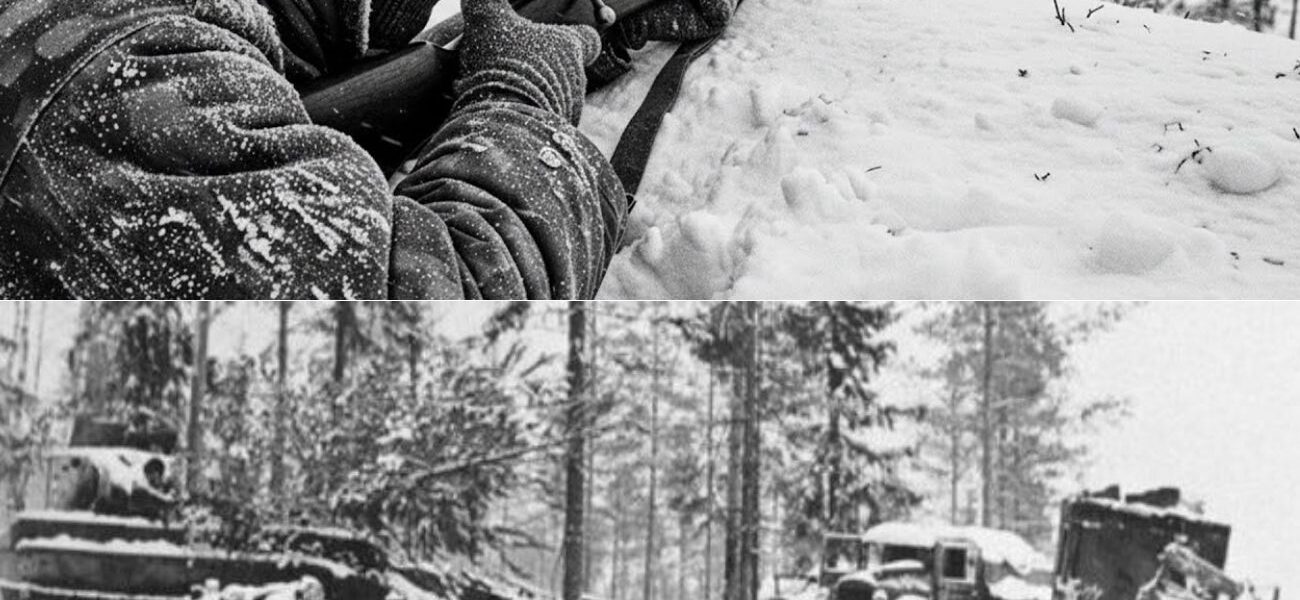
This Finnish farmer killed 542 soldiers – and none of them ever saw who was shooting.


At 6:47 a.m. on February 17, 1940, Corporal Simo Häyhä lay motionless in a snowdrift, 150 meters from a Soviet supply route near Kollaa, Finland. He observed a Red Army patrol of 12 soldiers marching through the frozen forest. The temperature was -43°C. The 34-year-old Häyhä had been in this position for four hours.
He wore no winter camouflage, only a white snow shirt over his standard Finnish army uniform. His rifle was a Mosin-Nagant M28-30 – without a scope, only with open sights. The weapon was 46 inches long, weighed 9.6 pounds, and had an internal five-round magazine of 7.62 x 54 mm R caliber ammunition. Häyhä had already killed 387 Soviet soldiers in 79 days of fighting.
The Soviets had sent snipers to find him. They had used artillery to destroy his positions. They had sent out patrols with orders to capture him alive. All had failed. Now, 12 more Soviet soldiers were approaching. They carried Mosin-Nagant 91/30 rifles with telescopic sights. They outnumbered Häyhä 12 to 1. None of them would see who was shooting. None of them would survive the next four minutes.
Simo Häyhä was born on December 17, 1905, in Rautjärvi, Finland, near the Russian border. His family were farmers; his father owned 150 hectares of land. They grew rye, potatoes, and hay, and raised cattle and pigs. The farm was isolated; the nearest town, Miettilä, was 8 km away and had 400 inhabitants. Häyhä was the second of eight children. He attended school until the age of 14, which was common in rural Finland, and then worked full-time on the farm. But Häyhä was no ordinary farmer. He was a hunter.
Finland’s forests of pine, spruce, and birch were home to moose, deer, foxes, wolves, and bears. Hunting provided meat for the winter and honed skills such as patience, camouflage, terrain reading, understanding wind, judging distances, and accurate shooting. Häyhä had been hunting since he was 12. By the age of 20, he was the best hunter in Rautjärvi. He could hit a running fox at 400 meters and remain motionless for hours in sub-zero temperatures. These skills would prove crucial.
In 1925, at the age of 20, Häyhä completed his compulsory Finnish military service. He served in the Suojeluskunta, the Civil Guard, Finland’s voluntary defense organization. The Civil Guard trained civilians for war, as Finland anticipated an attack. Russia had controlled Finland until 1917, and Finnish independence was still young. Häyhä’s training placed great emphasis on marksmanship. Finnish army doctrine prioritized rifle accuracy. Every soldier had to qualify at 150, 300, and 500 meters. Häyhä exceeded all standards.
At 150 meters, he hit his targets 97% of the time, at 300 meters 89%, and at 500 meters 72%. His instructors noted his exceptional precision and composure under pressure. After his military service, he returned to farming but continued to train with the Civil Guard and participate in shooting competitions, which he won repeatedly. By 1939, he had won several Finnish national championships. His competition rifle was a Mosin-Nagant M28-30, the same rifle he would use in the war.
The M28-30 was manufactured by SAKO, the Finnish arms manufacturer. It was a modification of the Russian Mosin-Nagant M91, but more accurate, with a better trigger, sights, and stock. Häyhä never used a telescopic sight; he preferred iron sights. Telescopic sights could fog up in the cold, glitter in the sun, and required raising the head, which magnified the silhouette. Iron sights were simple, reliable, and faster. Häyhä could acquire targets in 1.5 seconds, while the average with a telescopic sight was 2.8 seconds. Speed was crucial.
Häyhä was 1.60 meters tall and weighed 68 kg—small by Finnish standards, quiet, and reserved. He didn’t drink alcohol, didn’t smoke, and attended Lutheran church. No one expected him to become the deadliest sniper in history. But on November 30, 1939, the Soviet Union invaded Finland. Soviet Foreign Minister Vyacheslav Molotov falsely claimed that Finland fired first. This was a pretext; Stalin wanted Finnish territory.
The Red Army deployed one million soldiers, 3,000 tanks, and 2,500 aircraft. Finland’s entire army numbered 300,000 men, excluding tanks and with only 114 aircraft. The world expected Finland to capitulate within two weeks. But Finland fought back. Simo Häyhä reported to his unit and was assigned to Infantry Regiment 34 on the Kollaa River. His mission was simple: “Stop the Soviets. Kill anyone who crosses the river. Don’t let them advance.”
Am 7. Dezember 1939 griffen etwa 14.000 sowjetische Soldaten 4.000 finnische Verteidiger an. Die Sowjets nutzten Wellentaktiken, bei denen Verluste akzeptabel waren. Bis zum Abend waren 2.400 sowjetische Soldaten tot, während die Finnen nur 68 Verluste beklagten. Häyhä bemerkte, dass sich die Sowjets vorhersehbar bewegten; sie blieben auf Straßen und drängten sich zusammen. Seine Jagderfahrung hatte ihn gelehrt, dass vorhersehbare Beute leicht stirbt. Er bat um die Versetzung in die Rolle eines Scharfschützen, was genehmigt wurde. Ab dem 9. Dezember operierte er unabhängig.
Sein erster bestätigter Abschuss als Scharfschütze erfolgte am 10. Dezember 1939. Ein sowjetischer Offizier organisierte eine Patrouille in 250 Metern Entfernung. Häyhä zielte, atmete langsam aus und feuerte zwischen zwei Herzschlägen. Der Offizier fiel. Als sich ein weiterer Soldat dem Toten näherte, feuerte Häyhä erneut. Er hielt jeden Abschuss in seinem persönlichen Logbuch fest – klinisch und methodisch, wie ein Bauer, der seine Ernteerträge notiert.
Er entwickelte eine präzise Technik: Er verließ die finnischen Linien vor der Dämmerung, suchte sich Deckung in Schneewehen oder hinter gefallenen Bäumen und bereitete seine Position sorgfältig vor. Er klopfte den Schnee vor seiner Mündung fest, damit der Mündungsknall keinen losen Schnee aufwirbelte, der seine Position verraten könnte. Er hielt sogar Schnee im Mund, um zu verhindern, dass sein Atem bei -40 °C Dampfwolken bildete.
Im Dezember 1939 erzielte er durchschnittlich 5,3 Abschüsse pro Tag. Ein gewöhnlicher Scharfschütze erreichte 0,8. Er feuerte nie mehr als drei Schüsse aus einer Position ab, bevor er sich 50 Meter zurückzog. Die Sowjets nannten ihn „Belaya Smert“ – den Weißen Tod. Die Angst verbreitete sich; sowjetische Soldaten fürchteten den Kollaa-Sektor. Sie wussten nicht, dass der „Weiße Tod“ nur ein einziger Mann war; sie vermuteten ein ganzes Team von Scharfschützen.
Am 8. Januar 1940 entsandte das sowjetische Kommando spezialisierte Scharfschützen-Gegen-Teams mit Zielfernrohrgewehren. Doch auch sie scheiterten. Sie suchten nach Mündungsfeuer oder Atemwolken, fanden aber nichts. Als die Artillerie ganze Waldabschnitte unter Beschuss nahm, war Häyhä längst weitergezogen. Einmal infiltrierte ein achtköpfiges sowjetisches Team die finnischen Linien, um ihn zu hinterhalten. Häyhä spürte die Gefahr instinktiv, umging sie und schaltete vier von ihnen aus, bevor der Rest floh.
February 1940 was Häyhä’s deadliest month. Because the Soviet soldiers wore brown uniforms against the white snow, they were visible from 500 meters away. On February 17 alone, he killed 16 soldiers. By February 21, he had reached 387 confirmed kills. He was the deadliest sniper in world history, and the war was not yet over. The Soviets then changed their tactics and began a massive saturation bombardment of the entire area. In 12 days, 6,000 shells destroyed the forest, but Häyhä adapted and increased his tally to 460.
On March 6, 1940, the tide turned. During a skirmish, Häyhä was struck in the face by a Soviet bullet. The projectile entered his left cheek, shattered his jaw, and exited through his right cheek. His lower face was mangled, he was bleeding heavily, and he was in danger of suffocating. He lost his rifle but crawled 290 meters back to the Finnish lines. Comrades rescued him under heavy machine-gun fire.
He narrowly survived. The bullet missed his carotid artery by only 8 mm. While he lay in a coma, the Treaty of Moscow was signed on March 13, 1940. The Winter War ended. Finland remained independent but lost 11% of its territory, including Häyhä’s home region. He personally became a legend with 542 confirmed kills in just 98 days.
Häyhä remained in the hospital until July 1940. His face was permanently disfigured, yet he was promoted to lieutenant – an extraordinary honor. When Field Marshal Mannerheim asked him how he had become such a good shot, Häyhä simply replied with one word: “Practice.”
Due to his severe injuries, he could no longer participate in active combat, but he trained new snipers during the Continuation War. After the war, he lived as a humble farmer and hunter in Ruokolahti. He never married and rarely spoke about the war. When asked, he would say, “I did what was necessary, nothing more.”
In an interview at the age of 93, he declared: “I regret that the war took place. I regret that people died, but I do not regret my actions. Soviet soldiers invaded my country. They would have killed Finns. I stopped them. That was my duty.” When asked if he was a hero, he replied: “No, I was a soldier. Heroes are men who sacrificed themselves. I survived. I am just a farmer who learned to shoot.”
Simo Häyhä died on April 1, 2002, at the age of 96. He outlived the Soviet Union by eleven years. His rifle is now in the Military History Museum in Helsinki—a simple instrument in the hands of an extraordinary man. He proved that patience triumphs over technology and simplicity over complexity. His legacy is not the number of dead, but the Finnish concept of “sisu”: the unwavering determination never to give up, no matter how hopeless the situation may seem.