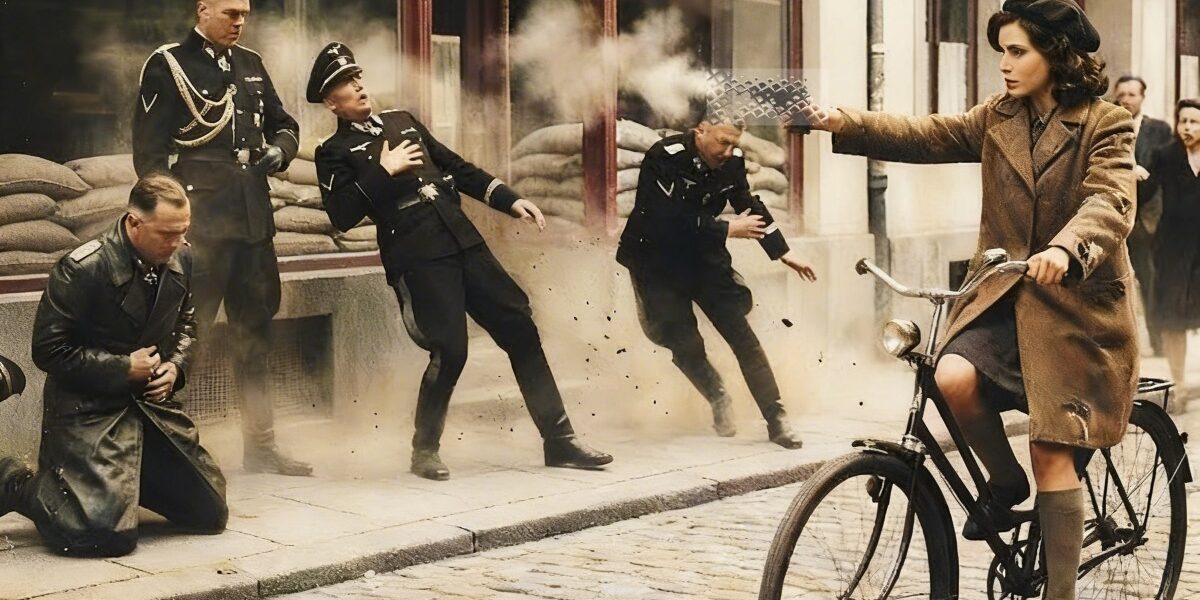
She looked like an ordinary girl with a bicycle — in reality she was a nightmare for the Nazis

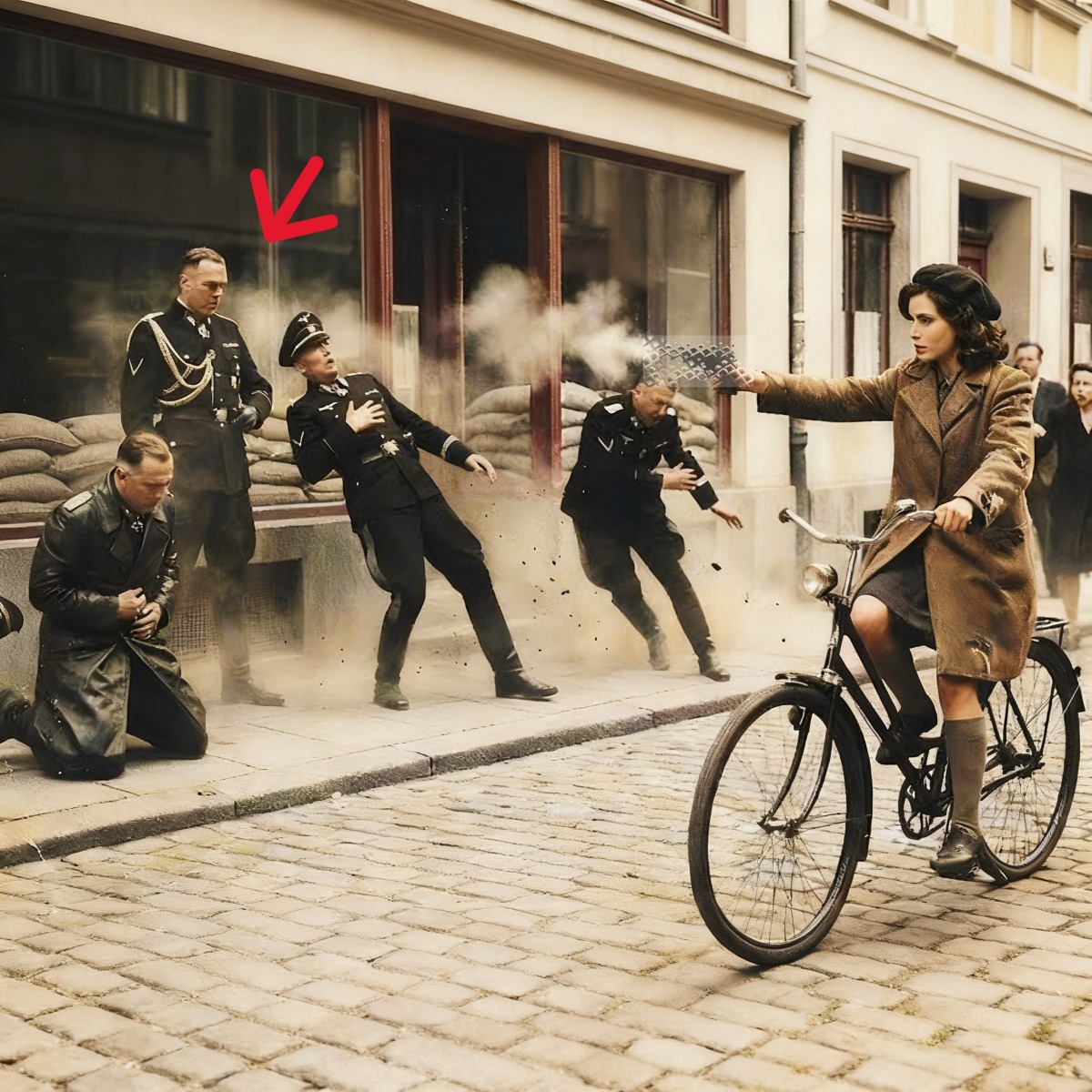
See how a 14-year-old girl’s “innocent” bicycle helped take out dozens of Nazi officers — without anyone suspecting a thing.
While German soldiers patrolled the streets of Haarlem searching for armed and dangerous resistance fighters, two teenage girls with braided hair and angelic smiles pedaled freely between checkpoints, carrying weapons hidden in their bicycle baskets. The Nazis would never have imagined that these fragile and innocent-looking girls were actually trained assassins, responsible for the elimination of dozens of high-ranking officers, traitorous collaborators, and SS men.
This is the true story of Freddy and Truus Oversteegen, two sisters who learned to kill in a dark basement at the ages of 14 and 16; who seduced their enemies in smoky bars and executed them in cold blood in isolated woods; who saved hundreds of Jewish lives while taking others without hesitation, but who never lost their humanity even as they fought true monsters.
Freddy was born in 1925 in the small village of Schoten, on the outskirts of Haarlem, in the Netherlands. His childhood was anything but normal or comfortable. The family lived in a modest prefabricated house on the outskirts of town. His father never managed to earn enough to adequately support them all. His mother, Truus Menger, was a staunch communist and taught her daughters an unwavering principle:
“When you witness an injustice unfolding before you, you can’t simply turn away and pretend you didn’t see it. You must act immediately to correct it, no matter what the personal cost.”
When Freddy was still very young, her parents divorced for good. Her father sang a melancholy farewell song in French from the bow of a boat as he departed for an unknown future, and Freddy rarely saw him after that sad day at the docks. Truus moved the two girls—Freddy and her older sister Truus—into a tiny, cramped apartment in the heart of Haarlem. They slept on old mattresses filled with dry straw that stung their backs at night.
The family owned almost nothing of value, yet the mother always found space to host others in need. Jewish refugees fleeing Nazi persecution knocked on the door in the middle of the night. Political dissidents fleeing the Gestapo desperately needed temporary shelter. They were complete strangers, often without even knowing their real names. They shared narrow beds and few resources. Freddy and Truus grew up making handmade dolls from scraps of fabric for traumatized refugee children from the Spanish Civil War.
They learned early that some things matter infinitely more than personal comfort or individual safety. Their mother taught them a lesson that would remain engraved forever:
“If you really want to help someone, you have to be willing to sacrifice something important: time, resources, comfort, or even your life.”
Then came the day that changed everything: May 10, 1940. Nazi Germany invaded the Netherlands with brutal and overwhelming military force. Tanks rolled across the border in perfect formation. Planes bombed defenseless cities. Paratroopers descended from the sky like deadly locusts. The Dutch army, totally unprepared for the Blitzkrieg, bravely resisted for five days of desperate and bloody fighting before surrendering to German superiority.
Freddy was only 14 years old when he saw his entire nation fall under the Nazi boots.
The occupation began immediately with cold efficiency. German soldiers occupied the main streets, boots pounding the pavement in impeccable formations. Huge red-and-black swastika flags hung menacingly from government buildings. New oppressive rules and paralyzing fears spread like a disease.
Freddy remembered that feeling vividly. Years later he said:
I vividly remember people being forcibly removed from their homes in the middle of the night, without warning. German soldiers banged on the doors with the butts of their rifles, a terrible clang that could be heard throughout the neighborhood. And they constantly shouted orders in German, their voices authoritative. It was frightening to hear those screams echoing through the dark streets as families were dragged out.
But the Oversteegen family didn’t hide. They decided to fight from day one. Freddy and Truus distributed anti-Nazi leaflets and underground newspapers, risking immediate execution if discovered.
At night, using homemade glue and paper, they covered propaganda posters with resistance slogans: “Holland must be free” and “Don’t work for Germany.” Then they fled on bicycles at full speed, their hearts in their throats, knowing that if caught, they would be shot without trial. But they were never caught: two young girls on bicycles rarely aroused suspicion.
In 1941, Franz van der Wiel, commander of the Haarlem Resistance Council, arrived. He wanted to recruit them for much more dangerous missions. He asked their mother:
“Can your daughters officially join the armed resistance and participate in combat operations?”
Freddy was 14, Truus 16. The mother said yes. The girls said yes.
But Franz wanted to test them: he returned disguised as a Gestapo man, complete with uniform and pistol, shouting in German and demanding to know where a Jew was hiding. Freddy and Truus refused to give in and reacted angrily, refusing to betray anyone even under threat of death. Franz then revealed the deception: test passed.
Then he explained:
“You will learn to sabotage bridges and railway lines to block troops and supplies. And you will learn to shoot to kill Nazis and collaborators.”
Freddy, with a nervous smile, said:
“Well, this is definitely something I’ve never done in my life.”
The mother gave the last piece of advice:
“Whatever happens, always remain human inside.”
The sisters trained in an underground warehouse: aiming, breathing, staying calm, and not hesitating. Their first mission was to set fire to Nazi warehouses: they distracted and flirted with the guards while others set the fire. It worked perfectly.
Then came the toughest mission: Freddy’s first target wasn’t a soldier, but a Dutch collaborator ready to hand over a list of hidden Jews. Freddy met her in a park, asked her name in a gentle voice, then fired a single shot.
After the war he said:
“The first strange thing that comes to mind is to run to that person and help them get up.”
The sisters developed techniques: luring officers into the woods, firing on the fly from their bicycles, or knocking on the target’s door.
In 1943, Hannie Schaft, a law student, joined them. Her red hair made her one of the most sought-after; she dyed it black and continued fighting.
They sabotaged railways, rescued Jewish children, forged documents, gathered intelligence for the Allies—and continued to target Nazis and collaborators.
But they refused a terrible order: to kidnap Seyss-Inquart’s children. They said no:
“We are not Hitlerites. The resistance does not kill innocent children.”
On March 21, 1945, Hannie was stopped at an unexpected checkpoint with clandestine newspapers and a pistol. She was arrested, interrogated, and tortured for weeks. The Nazis knew: they had captured someone crucial.
Share this story—and if it makes you think, consider passing it on. You never know who might need it.